
What is consumer electronics: your essential guide
Most people think consumer electronics are just TVs and game consoles, but that narrow view misses the bigger picture. These devices span everything from the smartphone in your pocket to the smart fridge in your kitchen, shaping how Europeans communicate, work, and manage daily tasks. Understanding what qualifies as consumer electronics and how the European market evolves helps you make smarter purchasing decisions, especially when navigating upgrade cycles and sustainability regulations that directly impact device longevity and repair options.
Table of Contents
- Key takeaways
- What are consumer electronics? Defining the scope
- The European consumer electronics market: scale, trends, and growth
- Challenges and regulations shaping European consumer electronics
- How to choose and upgrade your consumer electronics smartly in Europe
- Discover the latest consumer electronics at OnlineStore24
- Frequently asked questions about consumer electronics
Key Takeaways
| Point | Details |
|---|---|
| What counts as electronics | Consumer electronics include devices designed for personal use in entertainment, communication, and information processing beyond traditional TVs and game consoles. |
| Europe market size and growth | Europe generated 257.31 billion USD in 2024 and is projected to reach 480.53 billion USD by 2033, a compound annual growth rate of 7.21 percent. |
| Upgrade cycle drivers | Consumers upgrade smartphones every two to three years due to better cameras, faster processors, and 5G. |
| Sustainability regulations | Europe’s sustainability regulations affect device longevity and repair options. |
What are consumer electronics? Defining the scope
Consumer electronics refers to electronic devices designed for personal use in entertainment, communication, and information processing, distinct from professional or industrial equipment. These gadgets integrate seamlessly into your daily routine, whether you’re streaming content at home, tracking fitness goals on a run, or managing smart home systems remotely. The category spans far beyond traditional televisions and radios.
The most common examples include smartphones that handle calls and apps, tablets for browsing and reading, smartwatches monitoring health metrics, laptops powering remote work, audio systems delivering music, and home appliances like smart refrigerators and robotic vacuums. Gaming consoles, digital cameras, e-readers, and fitness trackers also fall under this umbrella. Each device serves a specific personal need rather than commercial operations.
Emerging categories continue expanding the definition. Virtual reality headsets immerse users in digital environments, augmented reality glasses overlay information onto the real world, and AI-powered gadgets like smart speakers respond to voice commands and learn user preferences. Wearable health monitors track biometrics in real time, while connected home security systems provide remote surveillance. These innovations blur the line between entertainment and utility.
Key characteristics that define consumer electronics:
- Designed for individual or household use, not business infrastructure
- Powered by electricity or batteries for portability and convenience
- Feature user interfaces optimized for non-technical consumers
- Integrate with other devices through wireless protocols like Bluetooth and Wi-Fi
- Receive regular software updates to add features and patch vulnerabilities
These devices transform how you interact with information and entertainment. A smartphone replaces separate cameras, music players, GPS units, and alarm clocks. A smart TV streams on-demand content without cable subscriptions. Wireless earbuds deliver high-fidelity audio during commutes. Understanding this scope helps you recognize which purchases qualify as consumer electronics and how they complement each other in a connected ecosystem.
The European consumer electronics market: scale, trends, and growth
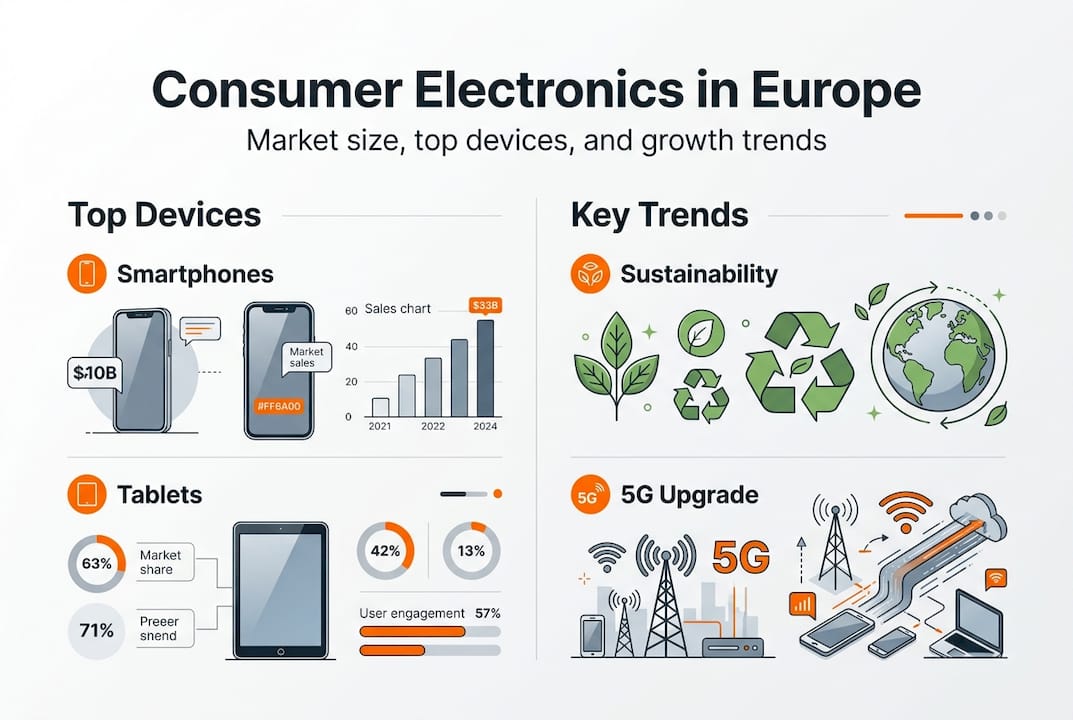
The global consumer electronics market generated approximately 1,046 billion USD in revenue during 2024, with 6 billion units sold worldwide. Europe’s share reached USD 257.31 billion in 2024 and analysts project growth to USD 480.53 billion by 2033, representing a compound annual growth rate of 7.21%. This expansion reflects increasing demand for connected devices, replacements of aging hardware, and adoption of emerging technologies like AI-powered gadgets.
Mobile phones dominate the market by both revenue and unit volume. Consumers upgrade smartphones every two to three years on average, driven by better cameras, faster processors, and 5G connectivity. Tablets maintain steady sales for education and entertainment, while smartwatches gain traction as health monitoring becomes mainstream. Audio equipment, including wireless earbuds and smart speakers, represents another high-growth segment as users prioritize portability and voice control.
European Consumer Electronics Market Snapshot (2024)
| Metric | Value |
|---|---|
| Total Market Revenue | USD 257.31 billion |
| Projected Revenue (2033) | USD 480.53 billion |
| Annual Growth Rate (CAGR) | 7.21% |
| Leading Segment | Mobile phones and smartphones |
| Fastest Growing Categories | AI gadgets, wearables, VR/AR devices |
Several trends shape purchasing behavior across Europe. Consumers increasingly demand devices with longer software support and easier repairability, influenced by sustainability concerns and rising device costs. Foldable smartphones attract early adopters seeking larger screens in compact form factors. Smart home integration drives sales of connected appliances, thermostats, and security cameras that communicate through unified platforms. Gaming hardware sees spikes during new console launches and graphics card releases.
Emerging technologies create new upgrade opportunities. Virtual reality headsets gain popularity for gaming and virtual meetings. Augmented reality glasses slowly enter consumer markets, though high prices limit adoption. AI-powered devices like smart displays and robotic vacuums learn user habits to automate tasks. Wearable health monitors expand beyond fitness tracking to include medical-grade sensors for blood oxygen, ECG readings, and sleep analysis.
Pro Tip: Check European smartphone options and tablet selections before upgrading to compare features, warranty terms, and compatibility with your existing devices.
Market data from Deep Market Insights shows regional variations in preferences. Northern European countries prioritize energy efficiency and eco-labels when selecting appliances. Southern markets favor smartphones with advanced camera systems for photography. Eastern European consumers balance budget constraints with demand for reliable hardware, driving sales of mid-range devices. These patterns influence which products manufacturers emphasize in regional campaigns and distribution strategies.
Challenges and regulations shaping European consumer electronics
Hardware failures significantly impact device usability and consumer frustration. Common issues include joystick drift caused by potentiometer wear in gaming controllers, TCXO bond wire fractures from ultrasonic cleaning processes, thermal throttling during fast charging that degrades battery health, and HDMI CEC conflicts where connected devices send incompatible control signals. Glued batteries complicate replacement attempts, forcing users to choose between expensive professional repairs or premature device disposal.
The European Union introduced ecodesign regulations for smartphones and tablets in 2024, mandating repairability scores on energy labels, 7-year spare parts availability, and 5-year software support commitments. These rules aim to extend device lifespans and reduce electronic waste. However, loopholes undermine effectiveness. Manufacturers can still glue components together, making disassembly difficult without specialized tools. Parts pairing, where replaced components require manufacturer authorization to function, remains legal and blocks independent repairs.
Key regulatory requirements affecting European consumers:
- Repairability scores displayed on product packaging and online listings
- Minimum 7-year availability for critical spare parts like batteries and screens
- At least 5 years of security updates and OS upgrades from release date
- Energy efficiency labels indicating power consumption during active use and standby
- Disclosure of expected battery cycle life before capacity drops below 80%
Despite these mandates, real-world repair challenges persist. Adhesives secure displays and back panels, requiring heat guns and prying tools that risk cracking glass. Proprietary screws and hidden clips deter casual users from opening devices. Software locks prevent third-party batteries or cameras from working even when physically compatible. These design choices prioritize slim profiles and water resistance over user serviceability, creating tension between aesthetic appeal and practical repairability.
Pro Tip: Before purchasing, verify whether replacement parts are available through official channels and check teardown guides to assess actual repair difficulty beyond manufacturer claims.
“EU regulations push manufacturers toward better repairability, but without banning parts pairing and glued assemblies, consumers still face significant barriers to extending device life through self-repair or independent service providers.”
Consumer behavior reflects mixed priorities. Surveys show 68% of Europeans value sustainability when buying electronics, yet price and features often outweigh repairability during purchase decisions. Many users attempt basic repairs like screen replacements, but lack of proper tools and fear of warranty voids discourage deeper interventions. The circular economy goals embedded in EU regulations face practical limits when device designs actively resist repair efforts, highlighting the gap between policy intent and manufacturing realities.
These challenges underscore why understanding eco-friendly gadget options matters. Devices built with modular components, standard fasteners, and readily available parts offer better long-term value despite potentially higher upfront costs. Regulations continue evolving to close loopholes, but current rules provide a starting framework for evaluating how long a device will remain functional and repairable throughout its intended lifespan.
How to choose and upgrade your consumer electronics smartly in Europe
Selecting the right consumer electronics requires evaluating multiple factors beyond specifications and price. Start by checking repairability scores on EU energy labels, which rate how easily you can disassemble and replace components. Devices scoring 7 or higher typically use standard screws, avoid excessive adhesive, and provide accessible battery compartments. Lower scores indicate glued assemblies or proprietary fasteners that complicate repairs and increase long-term ownership costs.
Assess software support commitments before purchasing. Manufacturers must now guarantee 5 years of updates for smartphones and tablets sold in Europe, but some brands exceed this minimum with 7-year pledges. Longer support means security patches and feature additions continue well into typical upgrade cycles. Verify whether updates include major OS versions or only security fixes, as this affects app compatibility and performance over time.
Modular designs extend device utility and reduce waste. Expert recommendations emphasize choosing products where batteries, screens, and storage components detach without specialized tools. Laptops with socketed RAM and replaceable SSDs let you boost performance years after purchase. Smartphones with removable back panels simplify battery swaps when capacity degrades. These features cost slightly more upfront but deliver savings by postponing replacement purchases.
Steps for evaluating consumer electronics before buying:
- Check the repairability score on the EU energy label and verify spare parts availability through manufacturer websites
- Confirm software support duration and whether updates include major OS versions or just security patches
- Review teardown guides from independent repair sites to assess real-world disassembly difficulty
- Compare warranty terms, noting whether self-repair voids coverage or if manufacturers honor right-to-repair regulations
- Calculate total cost of ownership including expected repairs, battery replacements, and potential resale value
Upgrade Approach Comparison
| Strategy | Pros | Cons | Best For |
|---|---|---|---|
| Annual upgrades | Latest features, trade-in value remains high | Expensive, minimal year-over-year improvements | Tech enthusiasts, business users |
| 3-year cycle | Noticeable performance gains, reasonable cost | Mid-cycle battery degradation | Average consumers balancing cost and features |
| Repair and extend | Lowest environmental impact, maximizes value | Eventually outdated, repair costs accumulate | Budget-conscious, sustainability-focused users |
| Buy refurbished | Significant savings, proven reliability | Limited warranty, older specs | Students, secondary devices |
Avoid common pitfalls that shorten device lifespan. Glued batteries force expensive professional service or risky DIY attempts. Paired components like cameras or fingerprint sensors won’t function after replacement unless authorized by the manufacturer, even when physically compatible. Check whether devices use standard ports like USB-C or proprietary connectors that limit accessory options and future-proofing.
Balancing cutting-edge technology with sustainability requires compromise. Foldable screens and ultra-thin profiles often sacrifice repairability for innovation. Evaluate whether bleeding-edge features justify reduced serviceability, or if proven designs with better repair access meet your needs. Comprehensive buying guides help compare trade-offs across categories, from smartphones to home appliances.
Pro Tip: Prioritize devices with at least IP67 water resistance and Gorilla Glass Victus or equivalent protection to reduce accidental damage, which remains the leading cause of premature replacement beyond planned obsolescence.
Timing purchases around product cycles maximizes value. New models typically launch in fall, causing price drops on previous generations that still receive years of software support. Refurbished units from reputable retailers offer warranties and significant discounts. Waiting three to six months after flagship releases lets you buy at lower prices without sacrificing meaningful features, especially when comparing electronics options across brands and price tiers.
Discover the latest consumer electronics at OnlineStore24
Ready to upgrade your tech with devices that match European standards and your lifestyle needs? OnlineStore24 specializes in consumer electronics delivered across the EU, offering everything from smartphones to smart home systems. Whether you need a reliable daily driver or want to explore the newest innovations, the selection spans budget-friendly to premium options with transparent specifications and customer reviews.
Explore the Xiaomi Redmi A3X smartphone for an affordable entry point with solid performance, or check the Radiant RAS10504 smartwatch to track fitness goals and notifications. Browse the full catalog at OnlineStore24 to compare features, read detailed product descriptions, and take advantage of secure EU-based fulfillment that gets your new devices to your door quickly and reliably.
Frequently asked questions about consumer electronics
What devices count as consumer electronics?
Consumer electronics include any personal-use electronic devices for entertainment, communication, or information processing. This covers smartphones, tablets, laptops, smartwatches, televisions, audio systems, gaming consoles, cameras, e-readers, and smart home appliances like thermostats and robotic vacuums.
How do EU regulations affect consumer electronics purchases?
European regulations require repairability scores on labels, mandate 7-year spare parts availability, and guarantee 5-year software support for smartphones and tablets. These rules help you choose devices with longer lifespans, though loopholes like parts pairing and glued components still limit practical repairability.
Why do mobile phones dominate the consumer electronics market?
Smartphones combine multiple functions into one device, replacing cameras, music players, GPS units, and computers for most daily tasks. Their versatility, frequent upgrade cycles driven by carrier promotions, and essential role in communication make them the highest-volume and highest-revenue segment.
What should I prioritize when upgrading consumer electronics?
Focus on repairability scores above 7, confirmed software support duration, modular designs with replaceable batteries, and compatibility with your existing ecosystem. Balance cutting-edge features against long-term serviceability, and time purchases after new model launches to capture price drops on previous generations.
Are refurbished consumer electronics worth buying in Europe?
Refurbished devices offer significant savings while meeting quality standards when purchased from reputable retailers. They typically include warranties, undergo testing to verify functionality, and receive the same software support as new units. This option works well for secondary devices or budget-conscious buyers seeking proven reliability.
Recommended
- Best Electronics for Modern Homes in Europe: Complete 2026 Buying Guide – OnlineStore24 EU
- Complete Electronics & Lifestyle Buying Guides for Europe 2026 – OnlineStore24 EU
- Best Electronics for Modern Homes in Europe (2026 Guide) – OnlineStore24 EU
- What is an eco friendly gadget? A 2026 European guide – OnlineStore24 EU