MacBook Air vs MacBook Pro 2026: Which Apple Laptop Should You Buy in Europe?
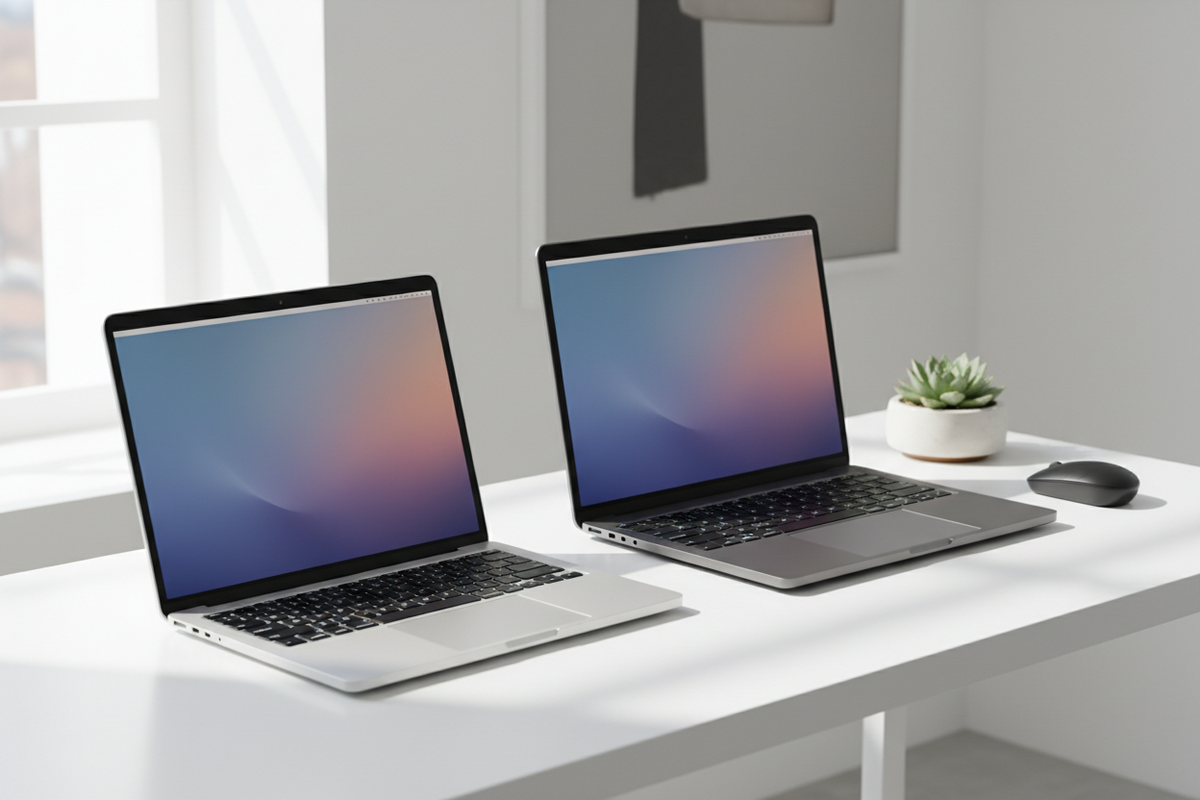
MacBook Air vs MacBook Pro 2026: Which Apple Laptop Should You Buy in Europe?
If you're trying to decide between the MacBook Air and MacBook Pro in 2026, you're choosing between two of the finest laptops available in the European market — and the decision is more nuanced than ever. Apple Silicon has transformed both lines, making even the entry-level MacBook Air a genuinely powerful machine capable of handling demanding creative and professional workloads. The MacBook Pro, meanwhile, has evolved into a specialist tool for users who need sustained peak performance, a superior display, and advanced connectivity. This guide gives you a clear, objective comparison to help you choose the right Apple laptop for your needs and budget.
At a Glance: MacBook Air vs MacBook Pro 2026
| Feature | MacBook Air | MacBook Pro |
|---|---|---|
| Design | Ultra-thin, fanless, lightweight | Thicker, fan-cooled, premium build |
| Weight | From ~1.24 kg (13") / ~1.51 kg (15") | From ~1.55 kg (14") / ~2.14 kg (16") |
| Chip options | M4 | M4 Pro / M4 Max |
| Display | Liquid Retina, up to 500 nits | Liquid Retina XDR, up to 1,600 nits, ProMotion |
| Battery life | Up to 18 hours | Up to 24 hours (Pro) / 22 hours (Max) |
| Ports | 2x USB-C / MagSafe | 3x Thunderbolt 4, HDMI, SD card, MagSafe |
| Sustained performance | Throttles under extended load | Full sustained performance |
| EU Energy Label | A / A+ | B / A |
| Starting price (EU) | Lower entry point | Significantly higher |
Design and Portability
The MacBook Air's defining characteristic is its design philosophy: maximum portability with minimum compromise. The fanless architecture — no cooling fan means no moving parts — results in a laptop that is completely silent in operation, exceptionally thin, and lighter than any MacBook Pro. For students, commuters, and professionals who carry their laptop everywhere, the Air's weight advantage is felt every single day.
The MacBook Pro is not a heavy laptop by any objective measure — the 14-inch model is genuinely portable — but it is meaningfully heavier and thicker than the Air. The additional mass accommodates the active cooling system (fans and heat pipes) that enables sustained peak performance, the larger battery, and the expanded port selection. For users who work primarily at a desk or carry their laptop occasionally, the weight difference is inconsequential. For daily commuters or frequent travellers, it matters.
Both models are built to Apple's characteristic standard of precision aluminium construction, with MagSafe charging on all current models. The MacBook Pro adds a notch display design that accommodates a 1080p webcam — a meaningful upgrade over the Air's 12MP camera for video calls and content creation.
EU note: Both MacBook Air and MacBook Pro include USB-C / Thunderbolt ports compatible with the EU's Common Charger Directive. MagSafe is an additional proprietary charging option, not a replacement for USB-C charging compatibility.
Performance: When Does the Pro Actually Matter?
This is the most important question in the MacBook Air vs Pro comparison — and the answer has changed significantly with Apple Silicon.
MacBook Air with M4
The M4 chip in the MacBook Air is a genuinely remarkable piece of engineering. For the vast majority of computing tasks — web browsing, email, document editing, video calls, photo editing, light video editing, coding, and even moderate creative work — the M4 Air delivers performance that would have required a professional workstation just a few years ago. The key limitation is thermal: without active cooling, the Air throttles its performance under sustained heavy loads to prevent overheating. For tasks that run continuously at full CPU/GPU utilisation for extended periods — rendering long video projects, running complex machine learning models, compiling large codebases — the Air will slow down after several minutes of peak load.
MacBook Pro with M4 Pro / M4 Max
The MacBook Pro's active cooling system allows it to sustain peak performance indefinitely. For professionals whose work involves sustained heavy computation — video editors working with 4K/8K ProRes footage, 3D artists rendering complex scenes, audio engineers running large plugin counts, software developers compiling large projects — the Pro's sustained performance advantage is real and meaningful. The M4 Max chip, available in the 14-inch and 16-inch Pro, adds significantly more GPU cores and unified memory bandwidth for the most demanding creative workloads.
The honest verdict on performance: If your heaviest regular task is video editing in Final Cut Pro or DaVinci Resolve with standard 1080p or 4K footage, the MacBook Air handles it well. If you're working with 8K RAW footage, heavy VFX, or running sustained ML training jobs, the MacBook Pro's sustained performance is worth the premium.
Display: The Pro's Most Compelling Advantage
The display difference between MacBook Air and MacBook Pro is significant and immediately visible.
MacBook Air display (Liquid Retina)
Excellent by any objective standard — sharp, accurate, and comfortable for all-day use. Peak brightness of 500 nits is adequate for most indoor environments. The display covers the P3 wide colour gamut and supports True Tone. For general use, it's a superb screen.
MacBook Pro display (Liquid Retina XDR)
A different class of display. Peak brightness of 1,000 nits sustained (1,600 nits for HDR content) makes it genuinely usable in direct sunlight and delivers spectacular HDR performance. ProMotion adaptive refresh rate (24Hz–120Hz) makes scrolling and animation noticeably smoother. The contrast ratio is dramatically higher, with deep blacks that the Air's LCD panel cannot match. For photographers, video editors, and designers who need accurate, high-brightness colour work, the Pro's display is a professional tool in its own right.
For students and general users, the Air's display is more than sufficient. For creative professionals whose work depends on accurate colour and brightness, the Pro's display justifies a significant portion of the price premium alone.
Battery Life and Energy Efficiency
Both MacBook lines deliver exceptional battery life by Windows laptop standards, but the Pro has a meaningful advantage in absolute terms.
The MacBook Air delivers up to 18 hours of battery life under Apple's test conditions — real-world usage typically yields 10–14 hours depending on workload. The MacBook Pro extends this to up to 24 hours on the Pro chip models, with real-world figures of 12–18 hours. For users who work away from power outlets for extended periods — on flights, in meetings, at coffee shops — the Pro's battery advantage is genuinely useful.
EU Energy Label: Both MacBook lines carry strong EU energy ratings. The MacBook Air typically achieves A or A+ ratings thanks to the M4 chip's exceptional efficiency. The MacBook Pro achieves B or A ratings — still excellent for a high-performance laptop, reflecting the higher power draw of the Pro and Max chips under load. Annual energy consumption figures are listed on the EU Energy Label for each specific configuration.
Ports and Connectivity
The MacBook Pro's port selection is one of its most practical advantages for professional users:
- MacBook Air: 2x Thunderbolt / USB 4 ports + MagSafe + 3.5mm headphone jack
- MacBook Pro (14"): 3x Thunderbolt 4 ports + HDMI 2.1 + SD card reader + MagSafe + 3.5mm headphone jack
- MacBook Pro (16"): 3x Thunderbolt 4 ports + HDMI 2.1 + SD card reader + MagSafe + 3.5mm headphone jack
For photographers (SD card reader), video professionals (HDMI out), and users who connect multiple peripherals simultaneously, the Pro's expanded port selection reduces or eliminates the need for a hub or dock. For general users, the Air's two ports are sufficient with a USB-C hub when needed.
Price and Value: Who Should Buy What
Choose MacBook Air if:
- You're a student, writer, or knowledge worker whose heaviest tasks are productivity and light creative work — see our best laptops for students in Europe 2026 for context on how the Air compares to the broader student laptop market
- Portability and weight are daily priorities
- You value silent operation (fanless design)
- Budget is a consideration and you want the best value Apple laptop
- Your workloads don't involve sustained heavy computation
Choose MacBook Pro if:
- You work with video, 3D, music production, or software development at a professional level
- Sustained peak performance is essential for your workflow
- The Liquid Retina XDR display matters for colour-critical work
- You need the expanded port selection without a hub
- Battery life beyond 15 hours is a regular requirement
For detailed configuration guidance on each model, see our dedicated guides: best MacBook Air for 2026 and best MacBook Pro for 2026.
Verdict: The Right MacBook for Your Needs
The MacBook Air is the right choice for the majority of European buyers — students, professionals, creatives, and everyday users who want the best all-round laptop available at a reasonable price. Its combination of performance, portability, battery life, and silence is unmatched in the Windows laptop market at equivalent price points.
The MacBook Pro is the right choice for professionals whose work genuinely demands sustained peak performance, a reference-quality display, or the expanded connectivity that the Pro's port selection provides. It is not a better laptop for general use — it is a specialist tool that justifies its premium for the users who need what it offers.
Conclusion: Choose Your Apple Laptop with Confidence
Both the MacBook Air and MacBook Pro represent the pinnacle of laptop engineering in 2026. Whichever you choose, you're getting a machine that will serve you exceptionally well for 5–7 years, backed by Apple's software update commitment and EU consumer law's 2-year minimum warranty.
Browse our full range of MacBook Air and MacBook Pro models at OnlineStore24.eu — with fast delivery across Europe, competitive € pricing, and expert configuration guidance to help you choose the right spec for your workflow. Your best laptop yet is waiting.